Simple Yoga Poses For Adults
Most adults do not need a complicated yoga routine. They need a handful of simple poses that fit into a busy day and do not require a gym membership or a flexible body. The poses below are basic, but they are not pointless. Each one targets a specific problem that comes from sitting at a desk, driving, or simply getting older. You can do them in order as a short routine, or pick one or two that feel right for your body on a given day.
Before you start, know this: you do not need to be flexible to do yoga. The poses below are meant to help you build mobility and strength over time, not to test how far you can stretch on day one. Use a folded blanket, a couple of thick books, or a chair if the floor feels too far away. That is not cheating. It is simple yoga poses for adults.
Why These Poses Matter for Adults?
Adults spend a lot of time in chairs. That changes how the hips, spine, and shoulders move. The hips get tight from sitting, the lower back aches from slouching, and the shoulders round forward from looking at screens. A simple yoga practice addresses these patterns directly. It asks you to move in directions you avoid during the day: to open the chest, to bend forward, to twist, and to stand on one leg. The goal is not to become a pretzel. The goal is to keep your body capable of doing the things you actually want to do, like picking up a child, carrying groceries, or getting up from the floor without groaning.
Cat and Cow: Wake Up the Spine
Start on your hands and knees. Place your wrists under your shoulders and your knees under your hips. If your knees feel sore, put a folded towel under them.
As you breathe in, let your belly drop toward the floor. Lift your chest and your tailbone at the same time. Your back will arch. This is Cow Pose. As you breathe out, round your back toward the ceiling. Tuck your chin and draw your belly in. This is Cat Pose .
Move back and forth between these two shapes slowly, matching the movement to your breath. Do not rush. The point is to move your spine through its full range, which most adults rarely do during the day. Cat and Cow warms up the back, the shoulders, and the hips. It is a good first pose because it asks very little of you. You just breathe and move.
Read Also: Gentle Yoga Poses For Beginners
Mountain Pose: Learn to Stand Properly
Stand with your feet hip-width apart. Let your arms hang by your sides. Now pay attention to how you are standing. Are you leaning on one hip? Is your belly relaxed and your lower back arched? Are your shoulders rounded forward?
To find Mountain Pose, bring your weight evenly across both feet. Press down through the base of your big toe, your little toe, and your heel. Gently tuck your pelvis so your lower back does not overarch. Lift your chest slightly and draw your shoulder blades back and down. Let your arms rest. Your head should feel balanced on top of your spine, not pushed forward .
This pose looks like nothing. It is actually one of the most useful poses for adults because it teaches you what good posture feels like. Most people slouch without realizing it. Mountain Pose gives you a reference point. Stand here for five or six slow breaths. Notice how your body feels when it is stacked properly.
Easy Pose: Sit Without Collapsing
Sit on the floor with your legs crossed. If your hips feel tight, sit on a folded blanket or a cushion. This raises your hips above your knees and takes pressure off your lower back and hip joints .
Now check your posture. Are you slumping? Are your knees higher than your hips? If so, add more height under you. Sit up tall. Let your hands rest on your knees or in your lap. Close your eyes if that feels comfortable. Stay here for a minute or two and breathe .
Easy Pose is harder than it sounds for adults who are used to chairs. Sitting cross-legged requires your hips to rotate outward, which they may not be used to. That is exactly why it is worth practicing. Do not force your knees down. Use the blanket. Over time, the hips will open, and the pose will feel more natural. If sitting on the floor is too uncomfortable, sit on the edge of a chair with your feet flat on the floor and your spine tall. The benefit is the same.
Standing Forward Bend: Release the Back
Stand with your feet hip-width apart. Bend your knees generously. Now hinge forward from your hips, letting your chest come toward your thighs. Let your head hang. Your hands can rest on your shins, on the floor, or on a couple of books if the floor is far away .
Do not worry about straightening your legs. Tight hamstrings are common in adults, and forcing straight legs pulls on the lower back in a way that is not helpful. Keep the knees bent. Focus on letting the weight of your upper body stretch your lower back. Stay here for five slow breaths. To come up, bend your knees more, press your feet into the floor, and roll up slowly. This pose counters all the sitting you do. It lets the back muscles release and gives your spine a gentle traction.
Tree Pose: Practice Balance
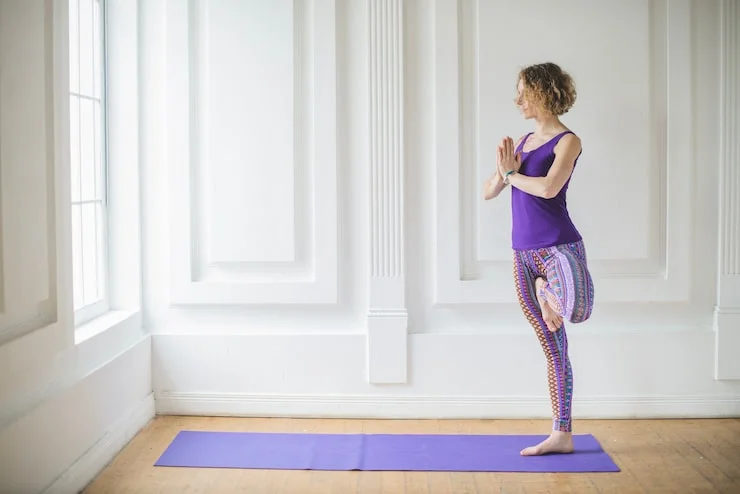
Stand tall. Shift your weight onto your left foot. Pick up your right foot and place it wherever it feels stable: on your ankle, on your calf, or on your inner thigh. Do not place it directly on your knee. Find a spot on the wall in front of you and stare at it. Bring your hands together at your chest .
Balance is a skill that gets worse with age if you do not practice it. Tree Pose asks your ankle, knee, and hip to work together to keep you upright. It also strengthens the standing leg. If you feel wobbly, that is normal. Stand near a wall so you can touch it with one hand if you need to. Stay for three to five breaths on each side. The wobbling is part of the practice. It means your body is learning.
You May Also Like: Yoga Postures For Lower Back Pain Relief
Child’s Pose: Rest
Kneel on the floor with your big toes touching and your knees apart. Sit back toward your heels. Fold forward and reach your arms out in front of you. Let your forehead rest on the mat or on a folded blanket. Breathe into your back .
This is a resting pose. It gently stretches the lower back and the hips, and it gives you a moment to stop doing. Adults often skip rest because they think they should be working harder. But rest is part of the practice. It lets your nervous system settle. Stay here for as long as feels good, anywhere from thirty seconds to a couple of minutes.
How to Put It Together?
Do these poses in the order above. Start with Cat and Cow to warm up the spine. Move to Mountain Pose to find your standing alignment. Sit in Easy Pose for a short breathing break. Do Standing Forward Bend to release the back. Try Tree Pose on both sides. End in Child’s Pose.
The whole sequence takes about ten minutes if you move slowly. You can do it in the morning before you start your day, or in the evening to unwind. The key is consistency, not duration. Ten minutes a few times a week will do more for your body than an hour once a month.
If something hurts, stop. Yoga should not cause sharp pain. Muscle effort is fine. Joint pain is not. If you have a history of back problems, knee injuries, or other health concerns, talk to a doctor or a qualified yoga teacher before you start. The poses here are simple, but every body is simple yoga poses for adults.